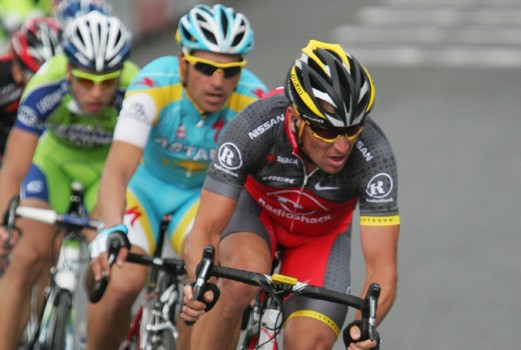
I have talked about the perception of fatigue. In my previous post I mentioned that Professor Tim Noakes states that “the brain, when it senses that the athlete is overstretching him- or herself, sets off a series of sensations that the body translates as symptoms of fatigue. The brain does so to protect itself, the heart and the rest of the body. “Its main function is to make sure you don’t get into trouble in whatever exercise you’re doing”.
I just completed my very first Cape Argus Cycle Tour, with a wind resisted time of 5 hours and 17 minutes. For the most part I felt stronger than I had expected, but there were times when all I could think of was “when will this end”. I have to wonder at what point my brain was correct when it told my legs, “hey slow down”. It is incredibly difficult to know how far to push yourself. Athletes who have down years of endurance training seem to develop an accurate sense of how far they can go. For those unschooled in endurance sports it is a process of trial and error.
Interestingly, in matters of adequate hydration, the brain seems unable to forewarn us of impending doom. In the last month I have come dangerously close to serious dehydration. When our brain eventually tells us that we’re thirsty it is usually too late and we’re already beginning to dehydrate (I wish it worked like that for food). In a recent Xterra (cross country triathlon) we raced in temperatures exceeding 40 degrees, and at least one competitor suffered severe and life threatening heat exhaustion. And in the Cape Argus Mountain Bike Challenge, also in temperatures exceed 40 degrees, one competitor suffered a heart attack.
For those of us who have never done endurance sports (like me), learning how far we can push ourselves is a real challenge. Either we hold back too much, or we push too fast and too soon. After a year of endurance training, the Cape Argus was the first time where I was able to keep my level of exersion in the “Goldilocks Zone” (not too hot and not too cold, just right) and it worked out well (at least to the top of Suikerbossie).
Suikerbossie was an interesting experience. After around 85km of cycling I decided that I would put everything into Suikerbossie and just cruise home (downhill all the way to the finish). So while others were walking or being pushed, I was out of the saddle and punching up the last big hill. My legs were screaming and my heart was thumping but everything was focused on this last big hill. Sadly, I had not factored in the strong head wind on the final stretch. I was spent and all I could think about was “I’m shattered and I just want this to end”. I think it was “mind over matter” on the way up Suikerbossie, and “mind over matter” on the way down.
I would love to hear your thoughts.
Endurance sport, in my opinion is 70 % mental fitness, 20 % attitude, and 10 % Physical ability. I have found that I can run further and better if my mind is not focussed on the run/ride/swim. When I am shatterred and just want the ride to end, then I end the ride in my mind and I think about something else – anything else, but it has to be something pleasant. During really long races/training sessions I try to think of every single person I have ever met, one by one, and then I try to remember as much as I can about that person and the different scenarios that transpired whilst with that person and usually long before I even think about High school – the race has ended and I usually want it to go on.
Thanks &ndrew. I have a friend who does complicated maths problems when doing long distance swimming training. I tried this tactic near the end of my first 10K race, except I opted for something easier – I tried counting backwards from 100 (although not as easy as it sounds when you’re gasping for air and your legs are burning). I have heard that one of the reasons that there are more older endurance athletes is because they have mastered the mental side of the sport.
Hi guys,
I agree with both of you. Andrew, I have also found that my pre-race mindset, as well as my mental state during the race, make a difference.
I’ve found the previous ‘victories’ no matter how small can be a source of encouragement. But, on the whole I do my best to enjoy what I am doing. I am a fairly competitive person, but since I am nearing the age where I have to accept that I will never truly compete to win, I spend a lot more energy on enjoying my training and ‘races’. I suppose this last bit also has something to do with my personality (I find people far more interesting than tasks).
Comments are closed.